
Advanced cardiovascular life support
AHA ACLS Classes in Jacksonville, FL
Strengthen your ability to recognize and manage cardiac arrest, stroke and other cardiopulmonary emergencies. Train with experienced instructors in a supportive, hands-on environment designed for healthcare professionals.
Select the correct initial, renewal or skills-session option on the live registration calendar.
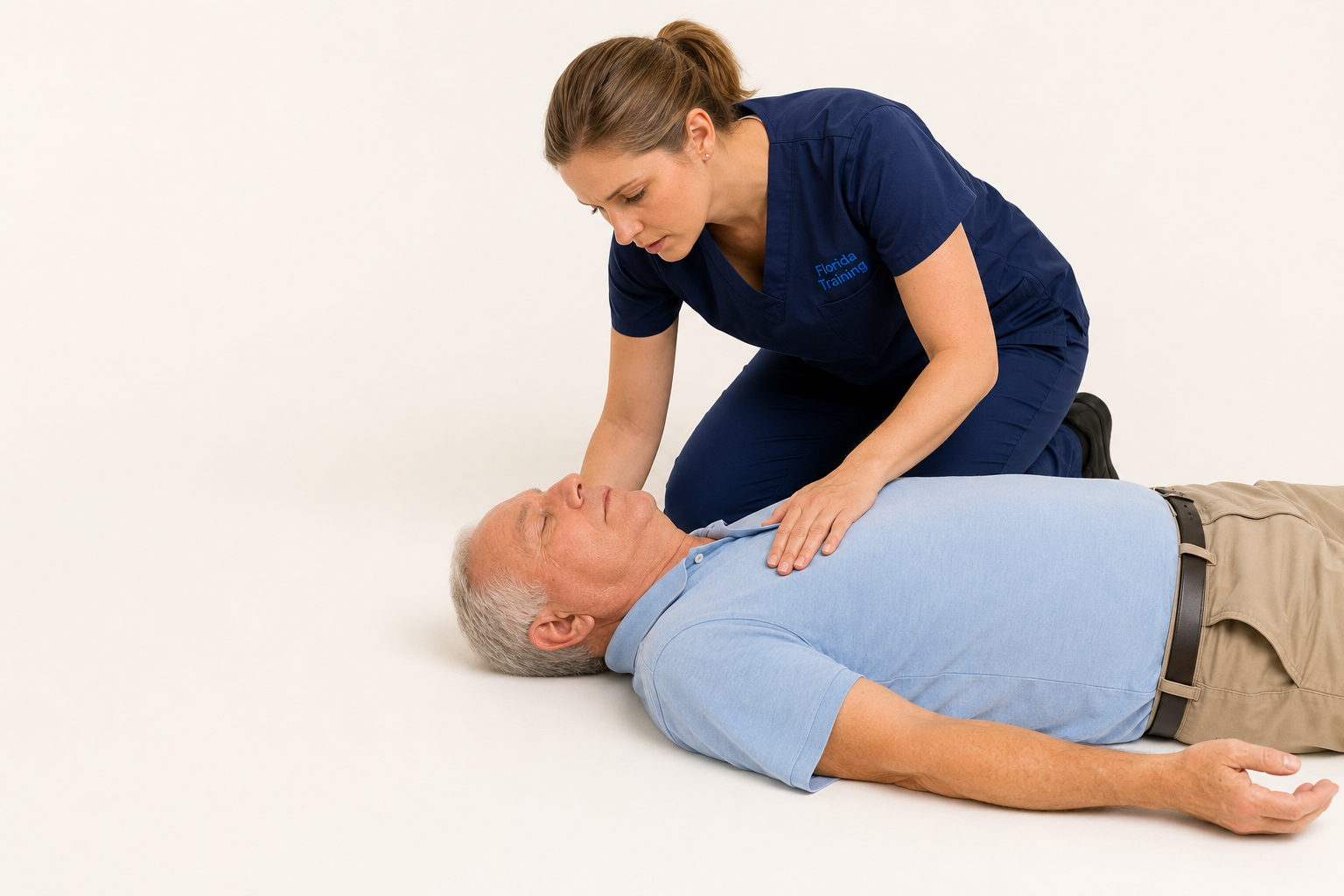
Who needs ACLS?
Designed for professionals who manage cardiovascular emergencies.
The AHA ACLS course is intended for healthcare professionals who direct or participate in the management of cardiac arrest, stroke and other cardiopulmonary emergencies.
Registered Nurses
Emergency, critical care, telemetry, procedural, surgical and other clinical nursing roles.
Physicians & Advanced Practitioners
Doctors, physician associates and nurse practitioners who lead or support resuscitation teams.
Paramedics & EMS
Prehospital professionals who assess and manage advanced cardiovascular emergencies.
Respiratory Therapists
Clinicians who assist with oxygenation, ventilation and advanced airway management.
Clinical Students
Students whose nursing, medical, EMS or allied-health program specifically requires ACLS.
Other Healthcare Professionals
Professionals whose employer, credentialing body or clinical assignment requires an ACLS card.
Choose your course
Select the ACLS option that matches your requirement.
Availability varies by date. Review the live registration description carefully before enrolling, especially when choosing between a full provider course, an update course and a HeartCode skills session.
ACLS Initial Provider
For healthcare professionals earning ACLS for the first time or completing the full provider-course pathway.
- Advanced cardiovascular assessment
- Cardiac-arrest and peri-arrest management
- Team dynamics and megacode practice
- Written and skills evaluations
ACLS Renewal / Update
For experienced providers refreshing current skills and completing the applicable AHA update-course requirements.
- Review of core ACLS algorithms
- Rhythm recognition and medications
- High-performance team practice
- Course evaluations for renewal
HeartCode ACLS Skills
For students who completed the required AHA HeartCode ACLS online portion and need an instructor-led skills session.
- Bring the required completion certificate
- Hands-on skills practice and testing
- Team-based scenario evaluation
- Confirm prerequisites before arrival
What the course covers
Build the clinical judgment to act as part of a resuscitation team.
ACLS builds on high-quality BLS. Students apply systematic assessment, rhythm recognition, electrical therapy, medications and team communication to adult cardiovascular emergencies.
- Recognition and management of cardiac arrest
- Shockable and nonshockable arrest rhythms
- Symptomatic bradycardia and tachycardia with a pulse
- Early management of acute coronary syndromes and stroke
- Airway, oxygenation and ventilation considerations
- Post–cardiac-arrest care after ROSC
- Closed-loop communication and high-performance teams
Before class
Prepare before you arrive.
ACLS is an advanced course—not an introduction to ECGs or basic CPR. Completing the assigned preparation makes the hands-on session more useful and less stressful.
Confirm Your Course
Verify whether you need initial, renewal or HeartCode skills testing.
Complete Prework
Finish all assigned AHA prework or online modules before the deadline.
Review Core Skills
Refresh BLS, ECG rhythms, ACLS medications, algorithms and team roles.
Bring Documentation
Bring required completion certificates and any items listed in your confirmation.
Frequently asked questions
ACLS class questions
Who should take an ACLS course?
ACLS is designed for healthcare professionals who direct or participate in managing cardiac arrest, stroke and other cardiopulmonary emergencies. Common participants include nurses, physicians, paramedics, respiratory therapists and advanced-practice clinicians.
Is ACLS the same as BLS?
No. BLS focuses on high-quality CPR, AED use, ventilation and choking response. ACLS builds on BLS and adds advanced assessment, rhythm interpretation, medications, electrical therapy and team-based management of adult cardiovascular emergencies.
Do I need a current BLS card?
ACLS assumes proficiency in BLS skills. Your employer, school or selected course option may require a current BLS Provider card. Review the registration description or contact us before enrolling.
How long is an AHA ACLS card valid?
The AHA ACLS Provider course-completion card is valid for two years through the end of the month in which it was issued.
Can ACLS be completed entirely online?
HeartCode ACLS uses online learning followed by an approved hands-on skills session. Completing only the online portion does not complete the full course or produce the final provider card.
What should I study before class?
Review high-quality BLS, rhythm recognition, cardiac-arrest pathways, symptomatic bradycardia, tachycardia with a pulse, key medications, reversible causes and effective team communication. Use the study sheets below as a review—not as a replacement for your official course materials.
Where are Jacksonville ACLS classes held?
Florida Training Academy is located at 631 Cassat Avenue, Jacksonville, Florida 32205. Check your confirmation for the exact arrival time and course instructions.
How much does the ACLS class cost?
Current prices are displayed with each option on the registration calendar. Select a class to review the course details and total before checkout.
Free study resource
ACLS Quick-Review Cheat Sheets
Use these original Florida Training Academy summaries to review high-yield concepts before class. Print them or keep the page bookmarked for study.
Florida Training Academy ACLS Quick Review
Adult advanced life support • Jacksonville, Florida • FLtraining.com
1. Adult Cardiac Arrest
Start strong
- Begin CPR, provide bag-mask ventilation with oxygen and attach the monitor/defibrillator.
- Compress at 100–120/min, at least 2 inches (5 cm) deep, with complete recoil.
- Minimize interruptions; change compressors every 2 minutes or sooner if fatigued.
Rhythm pathway
VF / pulseless VT
PEA / asystole
- VF/pVT: shock, immediately resume CPR for 2 minutes, obtain IV/IO access and repeat rhythm checks.
- PEA/asystole: epinephrine as soon as possible, CPR for 2 minutes and treat reversible causes.
Key medications
Epinephrine 1 mg IV/IO every 3–5 min Amiodarone 300 mg, then 150 mg Lidocaine 1–1.5 mg/kg, then 0.5–0.75 mg/kgVentilation
No advanced airway: 30:2. With an advanced airway: continuous compressions plus 1 breath every 6 seconds; use waveform capnography when available.
2. Symptomatic Bradycardia
Recognize
Bradyarrhythmia is typically a heart rate below 50/min. Determine whether it is causing cardiopulmonary compromise.
Signs of compromise
- Hypotension
- Acutely altered mental status
- Signs of shock
- Ischemic chest discomfort
- Acute heart failure
Immediate support
- Maintain the airway; give oxygen and assist ventilation when needed.
- Attach a cardiorespiratory monitor and monitor the pulse.
- Identify and treat the underlying cause.
Treatment when compromise persists
Atropine 1 mg IV Repeat every 3–5 min Maximum 3 mgIf atropine is ineffective: transcutaneous pacing and/or dopamine infusion 5–20 mcg/kg/min or epinephrine infusion 2–10 mcg/min. Consider expert consultation and transvenous pacing.
3. Tachycardia With a Pulse
Assess
Tachyarrhythmia is typically a heart rate of 150/min or faster. Support the airway and breathing, give oxygen if hypoxemic, monitor ECG/BP/oximetry, obtain IV access and acquire a 12-lead ECG when available.
Unstable?
- Hypotension
- Acutely altered mental status
- Signs of shock
- Ischemic chest discomfort
- Acute heart failure
If unstable: perform synchronized cardioversion and sedate whenever feasible. Use the device-recommended energy; if unknown, use the maximum energy setting.
If stable
- Narrow, regular: consider vagal maneuvers and adenosine.
- Wide QRS ≥0.12 sec: adenosine only if regular and monomorphic; consider an antiarrhythmic infusion and expert consultation.
4. Care After ROSC
Initial stabilization
- Assess and manage the airway; confirm advanced-airway placement.
- Use 100% FIO2 until oxygen saturation or PaO2 can be measured reliably, then titrate.
- Target SpO2 90%–98% or PaO2 60–105 mm Hg.
- Target PCO2 35–45 mm Hg unless severe acidemia is present.
- Use fluids and/or vasopressors as needed to target MAP ≥65 mm Hg.
Find and treat the cause
- Obtain a 12-lead ECG.
- Consider CT, ultrasound or echocardiography when clinically appropriate.
- Consider emergency coronary intervention for persistent ST elevation, cardiogenic shock, recurrent/refractory ventricular arrhythmias or severe ischemia.
If not following commands
- Use a deliberate temperature-control strategy with a goal of 32°C–37.5°C.
- Evaluate for seizures and obtain EEG.
- Use delayed, multimodal neurologic prognostication—generally ≥72 hours after ROSC or normothermia.
5. High-Quality CPR Checklist
- Rate: 100–120 compressions per minute.
- Depth: at least 2 inches (5 cm) for an adult; avoid excessive depth.
- Recoil: allow the chest to return fully after each compression.
- Interruptions: keep pauses as short as possible.
- Ventilation: avoid excessive rate or volume.
- Rotation: switch compressors every 2 minutes.
- Feedback: use audiovisual feedback and capnography when available.
- After a shock: resume compressions immediately.
6. Reversible Causes: Hs & Ts
Hs
- Hypovolemia
- Hypoxia
- Hydrogen ion excess (acidosis)
- Hypokalemia or hyperkalemia
- Hypothermia
Ts
- Tension pneumothorax
- Cardiac tamponade
- Toxins
- Pulmonary thrombosis
- Coronary thrombosis
Team reminder
Use closed-loop communication: assign a clear task, confirm the message was heard and report when the task is complete. Reassess rhythm, CPR quality and likely causes throughout the code.
Educational use only: These original summaries support course preparation and memory review. They do not replace the official AHA ACLS Provider Manual, full algorithms, clinical judgment, medical direction or your facility's protocols. Medication administration, electrical therapy and patient management must be performed by appropriately trained professionals within their authorized scope of practice. Always follow the current official AHA materials and local policies.
Ready to earn or renew your ACLS card?
Choose an upcoming AHA ACLS class in Jacksonville and review the course requirements before completing registration.