
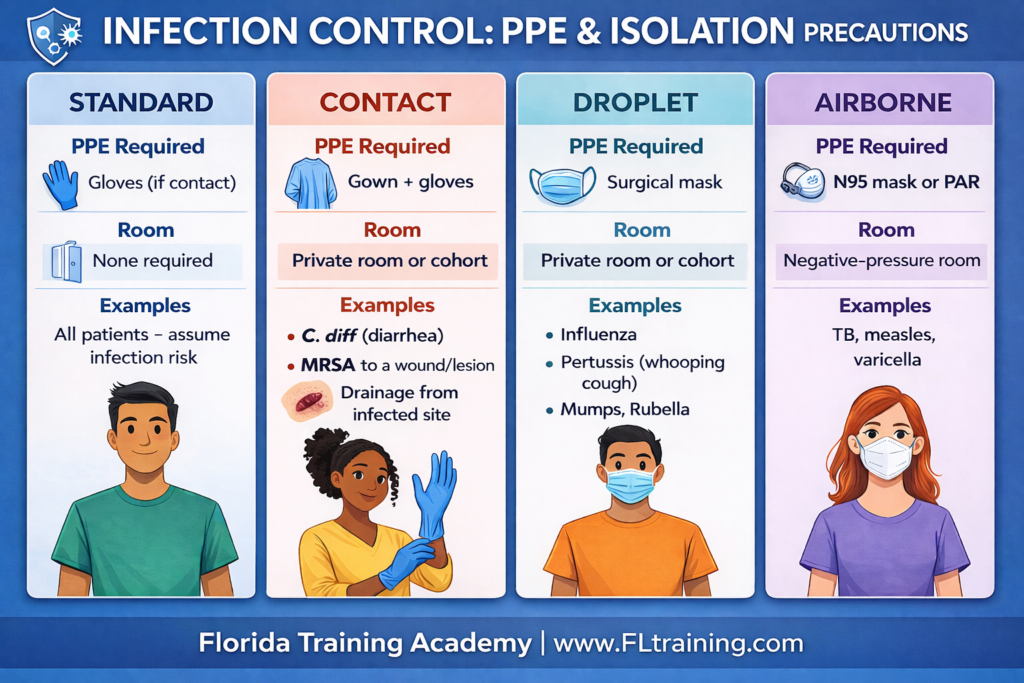
Infection control is one of the most important responsibilities in healthcare. Understanding how diseases spread — and what precautions to use — protects patients, healthcare workers, and the community.
Whether you are preparing for the CNA exam, entering nursing school, or working in patient care, you must understand Standard, Contact, Droplet, and Airborne precautions — and the concept of cohorting.
This comprehensive guide explains everything you need to know in one place.
🧼 Standard Precautions (Used for ALL Patients)
Standard Precautions are the foundation of infection control. They are used for every patient, regardless of diagnosis, because anyone may carry infectious organisms.
Key Practices Include:
- Hand hygiene before and after patient contact
- Gloves when touching blood, body fluids, mucous membranes, or broken skin
- Masks, eye protection, or face shields if splashing is possible
- Safe handling of sharps and contaminated equipment
- Respiratory hygiene (covering coughs and sneezes)
Think of Standard Precautions as your everyday safety routine in healthcare.
🧤 Contact Precautions (Spread by Touch)
Contact Precautions are used for infections transmitted through direct physical contact or contaminated surfaces.
Required PPE:
- Gloves upon entering the room
- Gown if clothing may contact the patient or environment
- Dedicated equipment for that patient only
Room Placement:
- Private room preferred
- Cohorting allowed with patients who have the same infection
Common Examples:
- Clostridioides difficile (C. diff)
- MRSA, especially in wounds
- VRE
- Uncontrolled draining wounds
- Certain diarrheal illnesses
⚠️ Important: For C. diff, handwashing with soap and water is required. Alcohol-based sanitizer alone is not effective.
😷 Droplet Precautions (Spread by Coughing or Sneezing)
Droplet Precautions are used for infections transmitted through large respiratory droplets that travel short distances.
Required PPE:
- Surgical mask upon entering the room
- Eye protection per facility policy
- Gloves and gown if contact with secretions is likely
Room Placement:
- Private room preferred
- Cohorting allowed with the same illness
Common Examples:
- Influenza
- Pertussis (whooping cough)
- Meningitis
- COVID-19 (depending on facility policy)
Patients should wear a mask during transport outside the room.
🌬️ Airborne Precautions (Spread Through the Air)
Airborne Precautions are used for infections transmitted by tiny particles that remain suspended in the air and can travel long distances.
Required PPE:
- N95 respirator (fit-tested)
- Eye protection per policy
- Additional PPE as needed
Room Placement:
- Negative-pressure room required
- Door must remain closed
- Cohorting is rare and only done under strict conditions
Common Examples:
- Tuberculosis (TB)
- Measles
- Chickenpox (Varicella)
Healthcare workers without proper respiratory protection should not enter these rooms.
🏥 What Is Cohorting?
Cohorting is a patient placement strategy used when private isolation rooms are unavailable.
Definition:
Cohorting means placing patients with the SAME confirmed infection together in the same room or care area.
Simple Way to Remember:
👉 Same germ = Same room = Same precautions
✅ Why Hospitals Use Cohorting
Healthcare facilities may cohort patients to:
- Conserve limited isolation rooms
- Manage outbreaks safely
- Prevent exposure of uninfected patients
- Maintain consistent PPE practices for staff
- Provide appropriate care when patient volume is high
🧪 Example of Safe Cohorting
Two patients diagnosed with C. diff may safely share a room under Contact Precautions because:
- Both patients already have the same organism
- There is no risk of introducing a new infection
- Staff use identical protective measures for both patients
Other cohort situations may include influenza outbreaks or MRSA wound infections, depending on facility policy.
🚫 When Cohorting Is NOT Safe
Patients with different infections must never be placed together.
Unsafe combinations include:
- C. diff with MRSA
- Tuberculosis with influenza
- Known infection with unknown infection status
- Patients requiring different isolation precautions
Mixing pathogens can expose patients to new and potentially life-threatening infections.
🧠 Understanding the Phrase “Private Room or Cohort”
You will often see this wording in policies, textbooks, and exam questions.
It means:
- A private room is preferred
- If unavailable, the patient may share a room ONLY with someone who has the same infection and precautions
Why This Matters for Healthcare Workers
Understanding isolation precautions and cohorting helps you:
- Protect vulnerable patients
- Prevent healthcare-associated infections (HAIs)
- Use PPE correctly
- Follow facility protocols confidently
- Succeed on certification exams
- Work safely in hospitals, long-term care, and home health
Even if you do not assign rooms, you are responsible for recognizing precautions and following them properly.
💙 Final Takeaway
- Standard = All patients
- Contact = Spread by touch
- Droplet = Spread by coughs or sneezes
- Airborne = Spread through the air
- Cohort = Patients with the same infection together
Mastering these concepts is essential for safe, effective patient care.
🎓 Learn More with Florida Training Academy
For step-by-step training, exam prep, and real-world healthcare skills:
🔔 Subscribe to our YouTube channels for caregiver education and skills training:
📺 Florida Training Academy: www.YouTube.com/FloridaTraining
📺 Eunice Mathis: www.YouTube.com/EuniceMathis
🌐 Visit https://FLtraining.com for CNA classes, study guides, certification prep, and healthcare training programs.
